Termite
Termites are silent destroyers that can cause severe structural damage. Learn about anti-termite treatments.
About the Termite
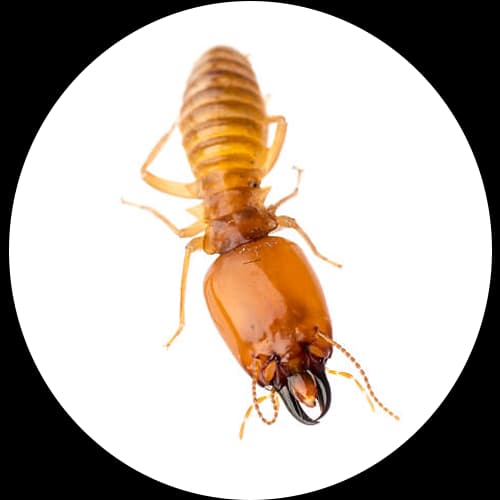
Termites also known as white ants live as a social colony consisting of queen, king, solders and workers. Queen controls and runs the society as leader for food, security and reproduction. Workers make the tunnel path to harvest cellulose food in any kind of materials in any place.
Termites mostly feed on dead plant material and cellulose, generally in the form of wood, leaf litter, soil, or animal dung.
Types of Termites:
- Dry wood termites or Wood nesting termites:
- Very rarely found
- Nest in wooden blocks
- Small colony
- Presence is confirmed when poppy seed like droppings are seen in the vicinity of the affected area.
- Sub-terranean termites or Soil nesting termites:
- Always nest in soil
- Construct mud tunnels
- Survive on old debris, stumps, etc.
- Only insect that is capable of digesting cellulose
- Causes enormous damages to property resulting in heavy losses
- It is a worldwide problem
Caste System:
Termites show 4 castes distinctly:
- Queen – Fertile females
Termite queens have the longest lifespan of any insect in the world, with some queens reportedly living up to 30 to 50 years. The queen of the colony is responsible for egg production for the colony.
- King – Fertile males
The king mates with the queen for life.
- Soldiers – Protect colony
Soldiers have enlarged heads, that are hard and yellow to brown in color, with large mandibles that are used to puncture termite enemies, primarily ants. The soldier caste has anatomical and behavioral specializations, and their sole purpose is to defend the colony.
- Workers – Damage property (Real Pests)
Are Blind and Sterile, Construct mud tunnel, causes damage to property and are millions in number. Worker termites undertake the most work within the colony such as foraging, food storage, and brood and nest maintenance. Workers are tasked with the digestion of cellulose in food and are thus the most likely caste to be found in infested wood.
Most worker and soldier termites are completely blind as they do not have a pair of eyes.
Life Cycle:
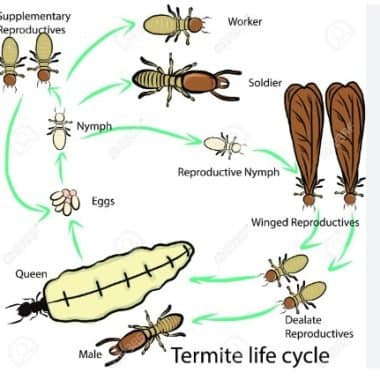
The life cycle of a termite begins with an egg, and goes through incomplete metamorphosis.
Egg to nymph and adult stages. Nymphs resemble small adults and go four moulting stages and nymphs go through three. Nymphs first moult into workers, and then some workers go through further moulting and become soldiers or alates.
Termite Communication:
Most termites are blind, so communication primarily occurs through chemical, mechanical and pheromonal cues. The most common way of communicating is through antennation. Termite antennae have a number of functions such as the sensing of touch, taste, odours (including pheromones), heat and vibration.
Termite Inspection
Termite management is challenging. Successful termite control begins with thorough termite inspection. Termites are not easy to detect.
Aim of a termite inspection is to determine:
- The location of all areas of termite activity
- The points of entry into the structure
- Potential areas for re-infestation
- The potential nest sites
- The areas posing difficulties or limitations for treatment
An inspector must have a good knowledge of the following:
- Termite biology and behavior
- Treatment practices
- Building construction
Route of entry:
- Along the drainage pipes
- Through walls
- Electrical cabling
- Conduit pipes
- Lift well
Inspecting the Interior:
Key inspection areas:
- Flooring: Gaps or loose tiles, Carpet – wooden strips
- Wall surfaces: Around windows and doorways, Near plumbing and electrical wiring, At the ceiling line
- Bookcases
- Air-conditioning units
- Plumbing areas and drains
- Power sockets, electrical conduit, telephone and television cables
SIPC Term –X Treatment
Successful termite control process by Pest Doctor include:
- Thorough termite inspection.
- Use of precise diagnostic techniques and identification tools like Moisture meter, Acoustic Devices, Movement Detection Devices (TERMITRAC) etc.
- Marking the root cause.
- Deciding the treatment with base plan of building is most essential as termites may re-enter along the drainage pipes, electrical cabling, conduit pipes and lift well.
- Apart from building area the perimeter ground will also be treated for 100% success.
SIPC Term X Post Anti-termite treatment:
- It is a post construction termite control service for existing buildings /structures with 7 years protection against termites.
- DRILL-FILL-SEAL technique is adopted with new generation systemic termiticides used as filling components.
- No damages to other structures.
- Can be applied to any kind of flooring materials without much damage.
- Perimeter areas may also be treated if required.
SIPC Term X Pre-Anti-termite treatment:
- It is a pre-construction termite control service for buildings /structures under construction with 10- 15 years protection against termites.
- Very effective as it creates a uniform chemical barrier around the building.
- We use new generation systemic termiticides which are accepted worldwide and is non-hazardous.
- Applied in three stages as: Stage 1 - Foundation, Stage 2 - Flooring and Stage 3 - Perimeter surrounding the building.