Housefly
Houseflies are common pests that contaminate food and surfaces. Find out how to keep them away.
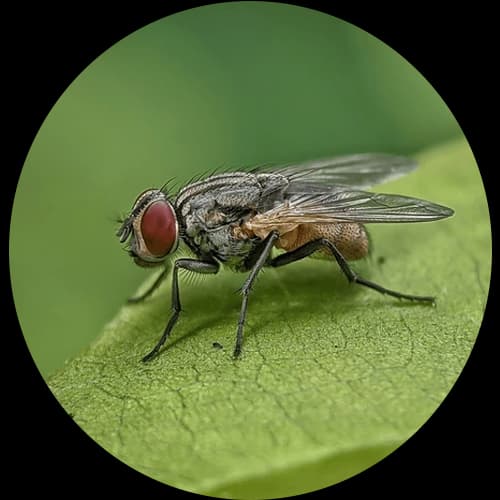
About the Housefly
Musca domestica is the most common house flies living as guests in our house.
Flies are also commensal (generally found living in close associations with humans and dependent upon human habitat for their basic requirements such as food, water, shelter, etc.) of humans.
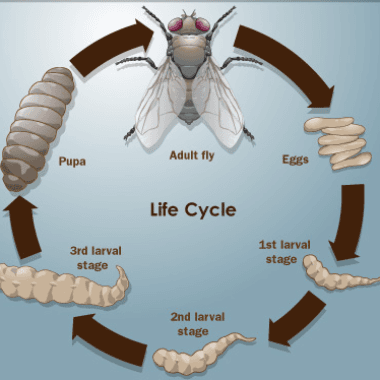
Life Cycle:
Each female Fly is capable of laying up to 2000 eggs in a lifetime. In several batches of about 75 to 150. The eggs are white and deposited by the fly on dead and decaying organic matter, such as food waste, or faeces.
At the end of their fourth instar, the larvae crawl to a dry, cool place and transform into pupae. The pupal case is yellowish at first, darkening to black as it ages. When metamorphosis is complete the adult fly emerges. 12 to 20 generations may occur per year.
Harmful effects of Fly to humans:
They can carry pathogens on their bodies and in their faeces, contaminate food, and contribute to the transfer of food-borne illnesses.
They alternate between breeding and feeding in dirty places with feeding on human foods, during which process they soften the food with saliva and deposit their faeces, creating a health hazard.
Houseflies can fly for several miles from their breeding places, carrying a wide variety of organisms on their hairs, mouthparts, vomit, and faeces.
They do serve as mechanical vectors to over 100 pathogens, such as:
- Typhoid
- Cholera
- Salmonellosis
- Dysentery
- Tuberculosis
- Pyogenic cocci
- Cysts of protozoa, e.g. Entamoeba histolytica and Giardia lamblia
- Eggs of helminths, e.g., Ascaris lumbricoides
SIPC IPM Techniques To Control Flies
Effective fly control programme should include:
- Identification of breeding site
- Control of sanitation
- Proper waste disposal
- Fly Population reduction
Flies can effectively be controlled by IPM (Integrated pest management) services offered by Pest Doctor.
SIPC IPM (Integrated Pest Management Techniques) Involves:
Larval Maggot-Control:
D-Tetramethrin-4.4% + Cyphenothrin-13.3% Residual Spray treatment sprayed on Garbage, Larval breeding muds, drainages, washing areas, Material receiving areas, etc.
Adults-Control:
- D-Tetramethrin-4.4% + Cyphenothrin-13.3% Residual Spray treatment. Sprayed on Garbage, Larval breeding muds, drainages, washing areas, Materials Receiving areas etc.
- SIPC Baits/Flyco Baits – Placed in Adults Movement areas
- SIPC PHERMONE TRAP to attract Male and combat them.
- SIPC Traps – 2 x 1.5ft Glue Trap, Ribbon rope Trap, & Electrical Fly
Flies can effectively be controlled by IPM (Integrated pest management) services at larval stage by using growth inhibitors and baiting, use of insect light traps, residual sprays and thermal chemical fogs.
For indoor issues of small flies’ i.e Drain flies, fruit flies, in sink drains and wash rooms, can be best control by use of effective chemical foaming the drains at regular interval which breaks the life cycle of such indoor small flies.